System architecture
When no-code stops working: architecture for scale
Recognise when no-code begins to block growth. Learn migration costs, risk signals and how to design scalable architecture without premature complexity.
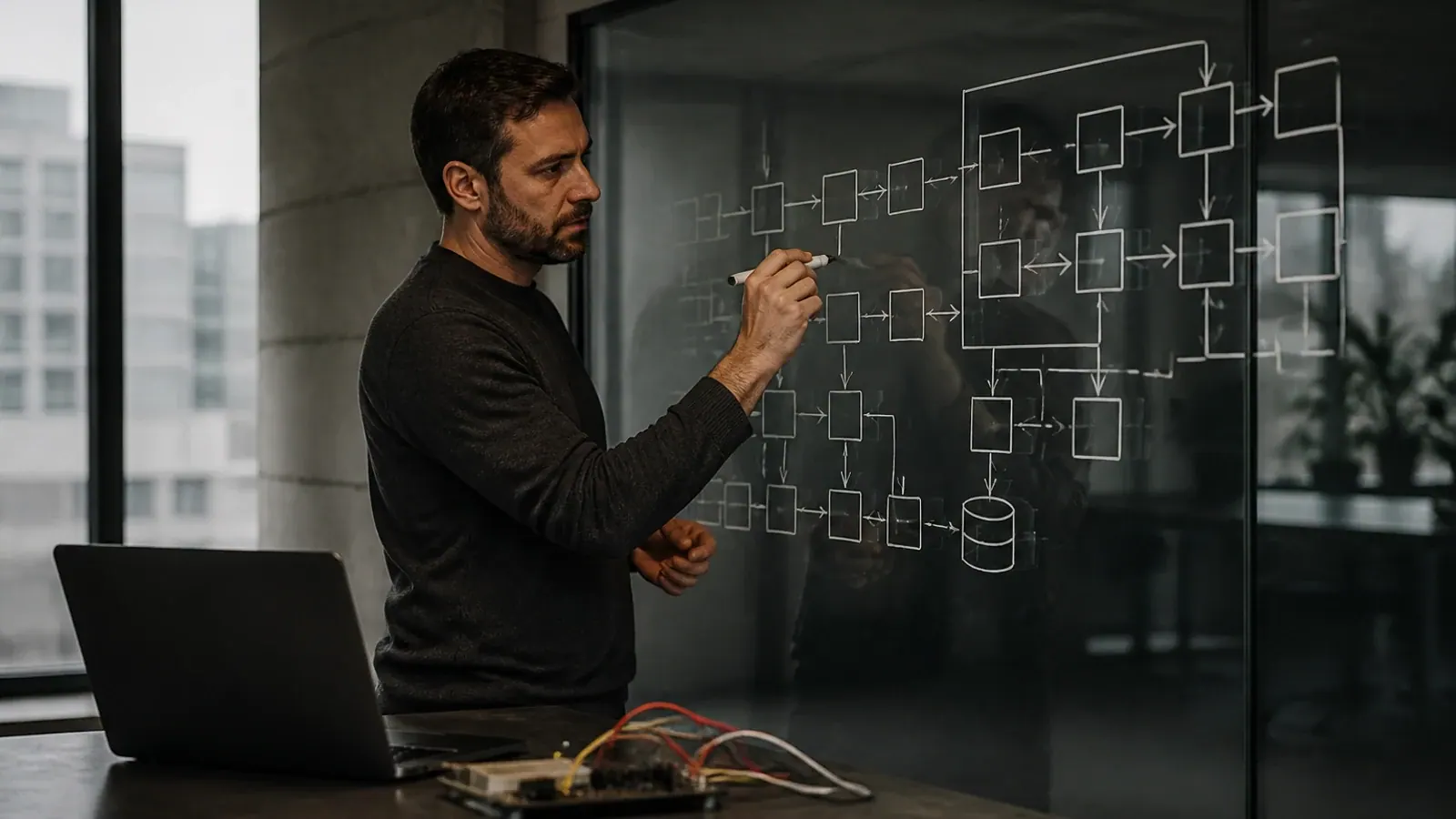
Short answer: no-code stops being sufficient when data, performance, security or change-cost constraints appear more often than the speed benefit. Do not migrate merely because user count grew. The Prolabs estimate for architecture work and staged migration is PLN 60,000 to 300,000 net, depending on data and process criticality.
No-code is effective for testing and internal processes. Trouble starts when logic becomes invisible, one scenario triggers hundreds of operations and nobody can safely change the data schema. Rewriting everything at once normally increases risk.
Migrate the constraint, not the technology. Keep the parts that still perform their job.
Which signals justify an architecture change?
These net budgets are Prolabs estimates. Remove the bottleneck before funding a complete rewrite.
| Scenario | Budget or threshold | Decision |
|---|---|---|
| Audit and dependency map | PLN 15k to 40k | before any migration decision |
| Extract critical module | PLN 40k to 120k | when one function limits the whole |
| Stage backend migration | PLN 80k to 300k | when data and logic need control |
| Complete rewrite | above PLN 200k | only with a strong business case |
These ranges start a conversation; they are not an automatic rate card. Data quality, integrations, ownership and the cost of failure change the scope. A useful proposal makes those dependencies explicit and says what it deliberately excludes.
Write down the current state before asking for a quote. Capture case volume, team time, tool cost, error count and the business outcome. The data does not need to be perfect. It needs to support a like-for-like comparison after the pilot. Without a baseline, discussion returns to opinion and an impressive demonstration can be mistaken for a better result.
Which signs show that the problem is already expensive?
- A schema change breaks many flows. Dependencies are invisible and untested.
- Operation cost grows faster than use. The tool billing model no longer fits.
- Data is duplicated. There is no consistent source of truth.
- Permissions are too broad. The platform cannot separate responsibility.
- Failure cannot be reconstructed. Logs and monitoring are insufficient.
One sign rarely justifies a large project. Several signs together usually mean that the company already pays for workarounds through manual effort, lost leads, unreliable reporting or slow decisions. An audit should then set the repair order instead of listing every feature that could be built.
Include the people who perform the work every day. They know exceptions hidden from the formal process and can point to places where a customer waits or data loses context. Their role should continue beyond one interview. Give them a test version, a short feedback path and an explanation of decisions made from their evidence.
Is the problem scale or disorder?
Measure response time, error count, operation cost and change lead time. Data cleanup and fewer flows can often solve the issue without migration.
Test this area on real data and one complete path before rollout. A document or mock-up will not expose exceptions, delays and manual workarounds. A short test with the process owner separates an actual constraint from a team preference.
Record the decision with its assumption, metric and review date. A later change then becomes a response to evidence rather than a failure. The record also helps the next person understand why the current scope exists.
How is a staged no-code exit planned?
Define the most painful boundary, add an API and move one module. Old and new paths can run together while results are compared.
Test this area on real data and one complete path before rollout. A document or mock-up will not expose exceptions, delays and manual workarounds. A short test with the process owner separates an actual constraint from a team preference.
Record the decision with its assumption, metric and review date. A later change then becomes a response to evidence rather than a failure. The record also helps the next person understand why the current scope exists.
Are microservices the next step?
Usually not. A modular monolith with explicit boundaries has lower operating cost and simpler tests. Split services when team scale or independent deployment requires it.
Test this area on real data and one complete path before rollout. A document or mock-up will not expose exceptions, delays and manual workarounds. A short test with the process owner separates an actual constraint from a team preference.
Record the decision with its assumption, metric and review date. A later change then becomes a response to evidence rather than a failure. The record also helps the next person understand why the current scope exists.
How is data protected during migration?
Name the owner of every record, define synchronisation, reconcile totals and keep a rollback plan. A migration without integrity tests creates two sources of truth.
Test this area on real data and one complete path before rollout. A document or mock-up will not expose exceptions, delays and manual workarounds. A short test with the process owner separates an actual constraint from a team preference.
Record the decision with its assumption, metric and review date. A later change then becomes a response to evidence rather than a failure. The record also helps the next person understand why the current scope exists.
What does this look like in a concrete example?
An application serves 12,000 active accounts across several no-code tools. Traffic is not the problem. One report takes 40 minutes and consumes thousands of operations. The team extracts reporting and the database while keeping the admin panel. Prolabs estimate: PLN 95,000 instead of PLN 260,000 for a complete rewrite.
The company starts with a small scope and a measurable result. It increases spend, changes the tool or stops only after evidence. That reduces the cost of learning and keeps control with the process owner.
Design the failure path as well. What does a customer see when an integration fails? Who receives an alert? Can the operation be retried safely? How does the team return to the previous version? These sound like technical questions, but they describe business continuity. A simple manual takeover often provides more safety than complex automation with no observability.
How do you define a safe first scope?
A good first scope proves one thing and leaves evidence for the next decision. It does not need to fix the entire company. It needs an owner, measurable outcome, review date and a clear exit if the hypothesis fails.
- Name the decision and process owner.
- Record the current state and workaround cost.
- Choose one outcome metric.
- Test the full path on real data.
- Define error handling and manual takeover.
- Plan knowledge and access handover.
- Set the date for the next-stage decision.
After the pilot or launch, schedule a results review and a decision about further investment.
After the first month, separate implementation defects from a failed hypothesis. Configuration can be repaired. Missing use or missing business impact requires a different decision. Decide in advance who may stop further spend and which evidence is sufficient. This discipline protects the budget better than a fixed backlog written before contact with real users.
Which data and sources should guide the decision?
Tool prices and platform rules change. These sources were checked in July 2026. Open the current price list and terms before signing. Figures labelled as a Prolabs estimate are planning scenarios, not market statistics.
- Source: Cloudflare Workers pricing. Current usage pricing and platform limits.
- Source: AWS Well-Architected Framework. Architecture review principles for reliability, security and cost.
- Source: Google Analytics ecommerce. Recommended measurement of product and purchase behaviour.
When comparing suppliers, ask how they manage risk. A technology list says little. Acceptance criteria, demonstration rhythm and decision records matter more. The proposal should separate essential scope, options and maintenance. The company can then reduce the first stage without removing safeguards for data, customers and continuity. Clear exclusions signal maturity rather than inflexibility.
Finally, request a short operating guide and a list of cases that require a specialist. The team should know which changes are safe, where errors appear and how to report an incident with useful context. This preparation reduces downtime and repeated small requests after launch.
Related reading
See the Prolabs service. SaaS MVP cost in 2026 and how to cut the scope safely, Agentic development: software cost and delivery speed, 10 small business automations that repay their cost. See the Natu.Care case study.
FAQ
Does a large user count require leaving no-code?
Not by itself. Review limits, response time, costs, errors and change speed. A sound no-code design can support substantial volume. The final scope depends on data, team and risk. A short diagnosis is safer than forcing the company into a ready-made package.
How long does no-code migration take?
The Prolabs estimate is 3 to 9 months for a staged process. Data, integrations, testing and parallel operation determine the schedule. The final scope depends on data, team and risk. A short diagnosis is safer than forcing the company into a ready-made package.
Must the frontend be rewritten?
Not always. The team can extract backend, data or one critical function and keep the current interface until its constraint becomes measurable. The final scope depends on data, team and risk. A short diagnosis is safer than forcing the company into a ready-made package.
What is the largest migration risk?
Data loss or inconsistency and undocumented logic. Mapping, reconciliations, logs and a rollback path are therefore essential. The final scope depends on data, team and risk. A short diagnosis is safer than forcing the company into a ready-made package. The answer should follow current company numbers, and the next step needs a measurable success condition.
When is no-code still the best option?
When the process changes frequently, risk is low, volume fits limits and the team can observe and maintain the solution confidently. The final scope depends on data, team and risk. A short diagnosis is safer than forcing the company into a ready-made package.
Related service: see scope and collaboration model.
Related reading

SaaS
SaaS MVP cost in 2026 and how to cut the scope safely
A SaaS MVP usually costs PLN 60k to 250k net. Learn what belongs in the first release and how to avoid burning the budget before real customers pay.

Websites
Website cost in 2026: realistic budgets and scope guide
A business website in 2026 usually costs PLN 8k to 80k net. See realistic ranges, what a quote should include, and when a cheap offer becomes costly.

E-commerce
Shopify vs WooCommerce for DTC: cost and decision guide
Shopify offers predictability and speed, WooCommerce more control. Compare total cost, margin impact, maintenance and operational risk for a DTC brand.